Monday, April 15, 2019

N.Y. TIMES, WASHINGTON POST AND REUTERS LEAD PULITZER WINS

The New York Times, The Washington Post and Reuters were the big winners at the Pulitzer Prizes on Monday, winning two awards each in the journalism category, while the South Florida Sun-Sentinel took the coveted public service prize and three awards were given to works related to Donald Trump's questionable actions.

Other prizes went to the Associated Press, Los Angeles Times, The Wall Street Journal, ProPublica, St. Louis Post-Dispatch, The Advocate of Baton Rouge, La., and cartooning freelancer Darrin Bell.

The mass shootings in Maryland, Florida and Pennsylvania also accounted for honors in three separate acknowledgements, while two awards were given in the international journalism category for atrocities oversees

The Pulitzer Board gave kudos to two publications that were affected by those horrible shootings in 2018: the student paper, The Eagle Eye, at Marjory Stoneman Douglas High School in Parkland, Fla., and the Capital Gazette in Annapolis, MD.

At the beginning of the announcement ceremony, Pulitzer Administrator Dana Canedy highlighted the work done by students at The Eagle Eye as they covered the Feb. 14 shooting that left 17 students and staff dead.

She later announced that a special citation was being given to the Gazette staff for their bravery in putting out a paper and online coverage of the shooting in its newsroom on June 28 that resulted in the deaths of four staffers.

See the entire list of journalism Pulitzers below:

Journalism

Public Service

For exposing failings by school and law enforcement officials before and after the deadly shooting rampage at Marjory Stoneman Douglas High School.

Breaking News Reporting

For immersive, compassionate coverage of the massacre at Pittsburgh’s Tree of Life synagogue that captured the anguish and resilience of a community thrust into grief.

Investigative Reporting

For consequential reporting on a University of Southern California gynecologist accused of violating hundreds of young women for more than a quarter-century.

Explanatory Reporting

For an exhaustive 18-month investigation of President Donald Trump’s finances that debunked his claims of self-made wealth and revealed a business empire riddled with tax dodges. 

Local Reporting

For a damning portrayal of the state’s discriminatory conviction system, including a Jim Crow-era law, that enabled Louisiana courts to send defendants to jail without jury consensus on the accused’s guilt.

National Reporting

For uncovering President Trump’s secret payoffs to two women during his campaign who claimed to have had affairs with him, and the web of supporters who facilitated the transactions, triggering criminal inquiries and calls for impeachment.

International Reporting

For relentless reporting that exposed the brutal killing campaign behind Philippines President Rodrigo Duterte’s war on drugs.

For expertly exposing the military units and Buddhist villagers responsible for the systematic expulsion and murder of Rohingya Muslims from Myanmar, courageous coverage that landed its reporters in prison.

Feature Writing

For a series of powerful, intimate narratives that followed Salvadorian immigrants on New York’s Long Island whose lives were shattered by a botched federal crackdown on the international criminal gang MS-13.

Commentary

For bold columns that exposed the malfeasance and injustice of forcing poor rural Missourians charged with misdemeanor crimes to pay unaffordable fines or be sent to jail.

Criticism

For trenchant and searching reviews and essays that joined warm emotion and careful analysis in examining a broad range of books addressing government and the American experience.

Editorial Writing

For editorials written with extraordinary moral clarity that charted the racial fault lines in the United States at a polarizing moment in the nation’s history.

Editorial Cartooning

For beautiful and daring editorial cartoons that took on issues affecting disenfranchised communities, calling out lies, hypocrisy and fraud in the political turmoil surrounding the Trump administration.

Breaking News Photography

For a chilling image that reflected the photographer’s reflexes and concentration in capturing the moment of impact of a car attack during a racially charged protest in Charlottesville, Va.

Feature Photography

For brilliant photo storytelling of the tragic famine in Yemen, shown through images in which beauty and composure are intertwined with devastation. (Moved by the jury from Breaking News Photography, where it was originally entered.)


PULITZER ANNOUNCEMENT LIVE

Watch the Pulitzer announcement live below:


Friday, March 29, 2019

DO NEWSROOMS NEED A MENSTRUAL BEAT REPORTER?

As Women's History Month draws to an end, one of the most important issues to women, and one that has seen a good boost in attention, should remain in media focus long after the closing of March: menstrual rights.

It's a topic most men do not even take into account, and many women remain embarrassed by, yet still something that remains under-covered and unfairly treated by society.

Most states still tax feminine products, while few public outlets provide them at no charge in restrooms that gladly stock toilet paper, paper towels and hand soap. Why not menstrual products for women whose monthly periods are as common and natural as washing ones hands?

The stigma remains in many cases because it involves something specific to women, who remain second class citizens even today, and sex, which for some reason continues to draw confusion, embarrassment and secrecy.

Our culture, especially the media culture, promotes sex in every form -- from pornography on the web to nearly-nude pictures in print. Sports Illustrated's swimsuit issue has long been its best selling edition each year -- and its not because of the hockey scores.

But while we live and breath sex in the media and daily life, discussing it -- especially the somewhat sensitive nature of menstruation -- still makes some people cringe.

We have seen great strides in the news and media for gender rights. Gay and lesbian citizens have seen huge gains in acceptance, in part due to the media and public demands, as well as the Supreme Court. And recent transgender and gender-neutral rights campaigns have sparked greater acceptance.

But when it comes to monthly periods, people wince and fail to look at a true equity issue for women, and for men who still may not understand all of the ramifications.

The transgender community has their own menstrual issues as well with non-binary and gender-neutral citizens often unsure how to handle the need for such products, or places to use them. 

I applaud two recent media projects that have raised the issue to a level of debate and discussion not seen before. First, the 2017 book, Periods Gone Public: Taking a Stand for Menstrual Equity, by Jennifer Weiss-Wolf, who happens to live in the same New Jersey town as me and has been a great advocate for women's rights.

I interviewed her when the book came out. She writes about how women are unfairly treated in areas ranging from women's prisons to schools to homeless shelters.

More recently, the Academy Awards honored the short documentary, Period. End of Sentence, with its Best Short Subject Documentary Oscar. That great film by Rayka Zehtabchi looked at how menstruation is handled in areas of India and other countries where women are not provided adequate products and men barely even understand the monthly event.

See a clip below:


But the media needs to do more. A quick search of The New York Times for 2018 found 94 mentions of menstruation, but 243 mentions of Kardashian. And the related issues are still a battle for many women.

A March 9 CNN Business story stated that even with more awareness, most working women are not provided menstrual products at their workplace: 

"It's surprisingly rare for workplaces to provide menstrual products for employees, and there's no standard as to how offices should approach the issue. Some have vending machines mounted on the bathroom wall, others provide baskets with multiple options, and still others opt out entirely, providing nothing at all. In a survey from Free the Tampons, less than half of women who were surprised by their period said they had access to a vending machine in a public bathroom"

And earlier this month, Newsweek reported on a state legislator in Maine who voted against a bill ensuring free feminine products for female prisoners. 

The bill passed the first round of approvals, but the fact one lawmaker found it unnecessary indicates more information is needed. The legislator, Richard Pickett, said, "Quite frankly, and I don’t mean this in any disrespect, the jail system and the correctional system was never meant to be a country club."

This feeds into the assumption that menstruation and periods are some kind of choice or unique occurrence when they are a natural part of life for more than half of the population, but still treated as a stigma or something to be shamed.

If news outlets want to truly honor Women's History Month, now and beyond, they should make a point of looking into all of these areas - from the unfair tax on tampons to the lack of products for women in public restrooms -- and not only report on them, but editorialize and demand change.

As the husband of one woman and the father of another, I remain astonished at the lack of such availability. It still amazes me that my daughter's high school -- and I am sure many others -- does not have feminine products in the women's restrooms -- even a machine from which to buy them. Some claim girls would steal and hoard them. Do we fear that with paper towels, toilet paper and soap? No. 

And that is just one example. With an issue that affects so many news consumers, you would think the press would want to serve that need and push for such equality.

Perhaps in some cases they should even assign a reporter to the "menstrual beat," either part time or full time.

In my many years of covering news issues I have come across newspaper beats ranging from a beer reporter to a journalist assigned specifically to Michael Jackson.  

The Salt Lake Tribune for many years has had a polygamy reporter.  

It's hard to argue that more people are affected by polygamy or beer than menstruation when so many equity issues related to this monthly event still exist.

There are dozens of menstrual blogs out there  -- from period.org/blog to thepelvicexpert.com -- with lots of a great information. But few of them have the journalistic expertise and wide-ranging reach of a mainstream news outlet.

I would think news outlets would want to tackle a subject that has a potential audience of more than 100 million affected people.

So, my fellow news people, go to it.
   

Tuesday, March 26, 2019

NEW STUDY FINDS GROWING LOCAL DIGITAL NEWS

From the Pew Research Center today:

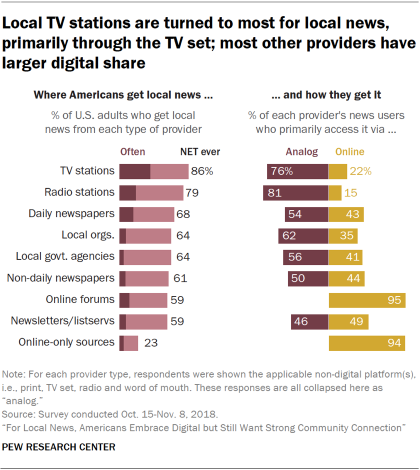
The digital era is making its mark on local news. Nearly as many Americans today say they prefer to get their local news online as say they prefer to do so through the television set, according to a new Pew Research Center survey of 34,897 U.S. adults conducted Oct. 15-Nov. 8, 2018, on the Center’s American Trends Panel and Ipsos’s KnowledgePanel. 

The 41% of Americans who say they prefer getting their local news via TV and the 37% who prefer it online far outpace those who prefer a printed newspaper or the radio (13% and 8%, respectively).
 
Charts showing that local TV stations are turned to most for local news, primarily through the TV set, and most other news providers have larger digital share.
Even as the preference for digital delivery creeps up on that for news via TV, local television stations retain a strong hold in the local news ecosystem. They top the list of nine types of local news providers, with 38% of U.S. adults saying they often get news from a local television station. That is followed by 20% who often turn to local radio stations and 17% who rely on local daily newspapers. 

Next come a range of less traditional sources such as online forums or discussion groups (12%), local organizations such as school groups or churches (8%), and community newsletters or listservs (8%). While individually these less traditional sources garner far smaller audiences than the big three (local TV, daily papers and radio stations), together they add up: 28% of the public often gets news from at least one of the six less traditional providers asked about.

See the full report HERE.


Friday, March 22, 2019

PRE-ORDER YOUR MUELLER REPORT ON AMAZON.COM THREE DIFFERENT WAYS - DOES THE JUSTICE VERSION HINT AT OBSTRUCTION?

It's interesting that as the anticipation grows for the FBI Mueller Report on Russian involvement in the 2016 election to be released, perhaps even today if you believe the MSNBC hype, that you can pre-order the report in at least three different ways online.

A quick search of Amazon.com finds a version that will include analysis from The Washington Post, another with an introduction from attorney Alan Dershowitz -- who wrote his own book against impeaching this president -- and the official version from the Justice Department itself.

Each is available in print and on Kindle. The Justice Department Kindle version seems to be the cheapest at just $2.99. Since it's unclear when the report will be issued, or if it will be public at all, the arrival date for your order remains a moving target.

As the Post version online order site states:

April 30, 2019 is a new placeholder publication date for The Mueller Report. The actual publication date for the ebook, audio, and paperback editions of The Mueller Report will be determined when and if the Special Counsel’s findings are made public.

The only book with exclusive analysis by the Pulitzer Prize–winning staff of The Washington Post, and the most complete and authoritative available.

Meanwhile, the online pitch from the Justice Department version seems to hint at a Trump link. It states:

The ongoing Special Counsel investigation (also referred to as the Mueller Probe or Mueller Investigation) is a United States law enforcement and counterintelligence investigation of the Russian government's efforts to interfere in the 2016 presidential election. This investigation includes any possible links or coordination between Donald Trump's presidential campaign and the Russian government, "and any matters that arose or may arise directly from the investigation." The scope of the investigation reportedly includes potential obstruction of justice by Trump and others. The investigation, since it began on May 17, 2017, has been conducted by the United States Department of Justice Special Counsel's Office, headed by Robert Mueller, a Republican and former Director of the Federal Bureau of Investigation (FBI). This book chronicles the legal actions Mueller has taken against Trump's associates in the 2016 Presidential Elections.

Stay tuned!

Sunday, February 3, 2019

WHY AREN'T MORE VIRGINIA NEWSPAPERS CALLING ON BLACKFACE GOVERNOR TO RESIGN?

Revelations that Virginia Gov. Ralph Northam apparently posed in blackface for a 1984 medical school yearbook photo has sparked calls for his resignation from three daily newspapers there, including the state's largest.

But most of the Virginia dailies, at least nine, have yet to urge his ouster following Friday's first reports that the photo depicting him in the racist image appeared in the Eastern Virginia Medical School annual.

Those that have called for him to step down include the largest circulation paper, The Richmond Times-Dispatch, as well as the Virginian-Pilot of Norfolk and The Daily Press in Newport News.

"He is by all accounts a decent and considerate man," The Times-Dispatch editorial board wrote Friday. "And yet, his poor judgment has undermined his standing with Virginians in ways that we believe will permanently impair his ability to act as an effective governor. He should resign and return to his profession as a physician, with the thanks of those he has served as a state senator, lieutenant governor, and for the past year, governor."

The co-owned Virginian-Pilot and Daily Press in a joint editorial stated: "Unfortunately, the bonds of confidence have been broken and they cannot be repaired. This Editorial Board endorsed Northam as governor to be the steady hand on the tiller, a man in whom we could trust. But we cannot anymore. Ralph Northam must resign."

But others that stopped short or have yet to editorialize on the story include The Roanoke Times, The Bristol Herald Courier, the Daily Progress of Charlottesville, The Culpeper Star Exponent, The Danville Register & Bee, The Free Lance-Star of Fredericksburg, The News & Advance of Lynchburg, The News Leader of Staunton, and the News Virginian of Waynesboro.

Some, like the Roanoke Times, came close, opining with the question: Can Northam still represent Virginia? Then punting when it came to their view: "Realistically, can Northam now represent Virginia in the way that people expect of their governor? Northam is a genial man who is well-liked on a personal level even by many Republicans. His low-key tone has been a welcome tonic to the poisonous politics we see on a national level. He has understood the way the economy is changing in deeper ways than many politicians. Sadly, none of that really matters now."

The News Leader called it "an unforgivable stain," but would not go all the way to urge a resignation.  

The Daily Progress has yet to weigh in on Northam and the blackface. But it might have won the bad timing award for an editorial it ran a day earlier, on Jan. 31, that advocated for a change to state law that would lift the current one-term limit on governors.

As for Northam, he hasn't helped himself much during this debacle. He first admitted that the blackface photo was his, then later claimed it was not and that he had not seen that yearbook page. But he did admit that he had worn blackface at another time, but said it was part of a costume depicting Michael Jackson.

It is this kind of divisive and offensive issue that allows those who oversee news operations to use their power and influence to call for change or improvements. If no more newspapers choose to do so, it will be interesting to see the impact.

One of the Virginia daily papers I do not expect to come around is the Star Exponent. During my research I came across an editorial that paper ran on Jan. 22 titled, "In Praise of Richard Nixon."

WASHINGTON POST'S FIRST SUPER BOWL AD HIGHLIGHTS JOURNALIST DANGERS - BUT MORE PRO-NEWS MESSAGES ARE NEEDED

The Washington Post will make some history of its own today with its first Super Bowl ad, which reportedly features Tom Hanks, who played legendary Post editor Ben Bradlee in 2017's The Post film about the Pentagon Papers.

The Post revealed that: "The 60-second spot, narrated by actor Tom Hanks, will air in the fourth quarter of the game, shortly before the two-minute warning. The commercial, produced in partnership with Mark Woollen and Associates, shows scenes from major news events from World War II through the present day. Hanks’s narration describes the role of journalists as eyewitnesses and gatherers of fact, as well as the profession’s larger importance to society. The commercial ends with The Washington Post’s logo and its slogan, 'Democracy Dies in Darkness.'"

That slogan was added to the Post just weeks after President Donald Trump took office in early 2017.

The commercial, which has not been released ahead of time, also highlights the dangers reporters face around the world, including those who worked at the Post.

Jamal Khashoggi
"The advertisement will briefly show several slain and missing journalists affiliated with The Washington Post and other publications," the paper reported. "They include freelance reporter Austin Tice, who has been missing in Syria for more than six years. Tice is believed to be alive, though his whereabouts are unknown. Another freelance journalist, columnist Jamal Khashoggi, was killed at the Saudi Arabian Consulate in Istanbul on Oct. 2, 2018.

"The CIA determined, with high confidence, that Saudi Crown Prince Mohammed bin Salman ordered Khashoggi’s assassination. A third journalist shown in the commercial, Marie Colvin, was an American war correspondent for the Sunday Times in London. She was killed in 2012 by Syrian forces while reporting in Homs, Syria. Colvin is the subject of the 2018 film 'A Private War,' and on Wednesday, a U.S. court ordered the Syrian government to pay $302 million in damages to Colvin’s family."

The ad comes just weeks after the Committee to Protect Journalists revealed that 54 journalists had been killed in the line of duty in 2018, the most in three years -- with three murdered so far this year. Since 1992, more than 1,300 have died on the job, according to CPJ. 

This is not the first time the Post took to video advertising to promote the need for a free and unfettered press. A year ago an ad pointing out the need for journalists to keep an eye on Trump was launched. See that below:


The New York Times in 2017 launched ads of its own that promoted basic journalism in the face of anti-press efforts, including one that took aim at the NFL concussion issue and ran just days before the big game. See below.


But it's not enough for major newspapers to remind news consumers of the challenges they face from anti-press attackers like Trump, and the dangers of doing the job. Other news outlets, especially broadcast and cable networks themselves, should use their airwaves for such public service announcements.

The News Media Alliance, formerly the Newspaper Association of America, recently produced a strong of video ads dubbed the "Support Real News" campaign. These ads push the point home about the need for a vibrant press. See one below:


But have you seen them on your local TV or cable station? Individual outlets need to step up and put the word out before the opposition to real journalism snuffs it out for good. 

Hopefully this starts a trend of news outlets pointing out to citizens and voters the need for a strong press, the need to support it financially, and the dangers that continue to grow for those who practice the profession.

Friday, February 1, 2019

PROPUBLICA GOING STRONG 10 YEARS IN, AND THE MONEY KEEPS COMING

ProPublica.org has ended its 10th year with an annual report out this week and a clear record of great non-profit journalism, as well as what appears to be a steady stream of financial contributions.

The non-profit outlet that launched in 2008 with $10 million in donations and a staff of 20 now boasts 120 people and revenue that exceeded $30 million last year, according to the report. It also claims more than $25 million in reserves.

See the financials below and the entire report HERE.

I remember when the non-profit news organization, which has already garnered a handful of Pulitzer Prizes, launched back in 2008. A decade-plus later, the unusual idea of an investigative news outlet that provides its news at no charge, with no advertising, and pure donations to exist seems to have been proven a success.

The annual report, titled "Ten Year's On,"states: "Our journalism spurred a host of real-world changes, including the reversal of President Donald Trump's migrant family separation plan; the first federal legislation in decades addressing maternal deaths; the end of a Facebook practice that facilitated discrimination; and the resignation of leaders from a troubled children's charity operating in Liberia."

Dozens of other non-profit news outlets have also come into the fold in recent years with great investigations from California to New Orleans. Let's hope this will spark even more profitless efforts at a time when the news industry needs strong, in-depth reporting that focuses on the news and not the need for higher profits.

Thursday, January 31, 2019

NEW YORK TIMES CELEBRATES ROBINSON'S 100th BIRTHDAY WITH 100 PHOTOS SECTION

Photo: NY Times
Bravo to The New York Times, which ran a special 24-page section today on the 100th birthday of Jackie Robinson. Along with short stories on the hall of famer, it included 100 historic photos.

The section included no advertising, just reflections on the man properly praised for breaking the baseball color barrier back in 1947.  Robinson, who died in 1972, was described in the section as a "ballplayer, a change agent, a human being and humanitarian — of America, in progress."

"When we began our 2019 editorial planning, Jackie Robinson's 100th birthday stood out as a really important moment," Veronica Chambers, the paper's editor of archival storytelling said in a statement. "He's the very definition of an iconic American who continues to be relevant and inspiring, decades after his death. 

Photo: NY Times
"As we digitize the six million photos in our archives, the Past Tense editorial team has been creating stories and editorial packages with the photos we're discovering," she added. "Since Jackie Robinson stepped into history in Brooklyn, here in New York, we knew that we'd have a strong collection of images from which to begin the ambitious project of assembling 100 photos for his 100th birthday."
 
The photos go beyond his years with the Brooklyn Dodgers, to his time as a UCLA football player, a World War II U.S. Army soldier (who faced a court martial for refusing to move to the back of an Army bus some 11 years before Rosa Parks), and an early civil rights advocate.

Photo: NY Times
"As these photos make clear, Robinson’s decade in major-league baseball was just one act in a remarkably rich and complex life — one of vision, fortitude, dignity and endurance," editors wrote. "Shaped by the currents and contours of American history even as it recast them."

See it all HERE.

Monday, January 21, 2019

LESSONS FROM BUZZFEED AND THE VIRAL CATHOLIC STUDENTS VIDEO

Two controversial news stories that received widespread attention in the past few days, and have since come under scrutiny, point to some of the most important issues facing the news media today: accuracy and checking all facts.

First, Buzzfeed.com's report last Thursday that former Trump attorney Michael Cohen had been ordered by Trump to lie to Congress.

Buzzfeed posted the story Thursday evening, which stated: 

President Donald Trump directed his longtime attorney Michael Cohen to lie to Congress about negotiations to build a Trump Tower in Moscow, according to two federal law enforcement officials involved in an investigation of the matter.

Trump also supported a plan, set up by Cohen, to visit Russia during the presidential campaign, in order to personally meet President Vladimir Putin and jump-start the tower negotiations. “Make it happen,” the sources said Trump told Cohen.

The story drew wide-range reaction among many news outlets as the supposed bombshell gave them plenty to chew on for days, with some saying impeachment proceedings should begin.

On Friday, a spokesman for Special Prosecutor Robert Mueller issued a strong rebuke of the story, stating:

BuzzFeed's description of specific statements to the Special Counsel's Office, and characterization of documents and testimony obtained by this office, regarding Michael Cohen's Congressional testimony are not accurate

Buzzfeed has since stood by its reporting, with Editor-in-Chief Ben Smith telling CNN on Sunday that the news outlet sought reaction from Mueller's office before any story was posted and essentially received a "no comment." He had the emails to prove it.

But many have piled on Buzzfeed, which has come under scrutiny in the past, but also shown true investigative journalism. Trump supporters claim this is a sign that the president's baseless past claims of fake news are true. That is not the case, of course, and even humorous given that Trump lies far more often than any news site.

It will take some time to see how the story plays out before we know if it's right or wrong. But to attack the entire industry for what may or may not be an honest and rare mistake is unfair. 

The story is an indication of how anonymous sources, who were the origin of this story, can be both useful -- if it is accurate -- and problematic if it turns out not to be.

I address many of these issue in my new book, Killing Journalism: How Greed, Laziness (And Donald Trump) Are Destroying News And How We Can Save It (Willow Street Press). 

Another story of note is the viral video of some Kentucky high school students at the Lincoln Memorial on Friday that appears to show them taunting some Native American activists who were chanting and playing music. 

See the partial clip that made the rounds below: 


Initial reports claimed the students of Covington Catholic High School had been verbally abusing the Native Americans and shouting racist taunts at them. Many were also wearing pro-Trump "Make America Great Again" caps.

But later reporting found a much longer video that indicated the incident began when a group of what USA Today described as "Black Hebrew Israelites" confronted the Native Americans and accused them of losing their native lands because they "worshiped the wrong god."

The video shows that the high school students, who were in town for the annual Pro-Life March, entered the fray only after it had begun and, according to some, were also confronted by the Black Hebrew Israelites who made anti-Catholic comments.

See the lengthy video below:


This story is another example of what can happen when home-made video is posted online with no real explanation and a lack of context. Accusations fly, reactions are heated and misinformation gets out.

In both cases, first reactions appear to have been based on reporting that was at least partially wrong or incomplete. In the viral news world, they spark widespread misunderstanding and too often leave the well-meaning journalists with a lot of explaining to do.

Both are also reminders that first reports need to be carefully handled with efforts to fully explain a situation and give time and resources to completely report it. 

Tuesday, January 8, 2019

WHY THE NETWORKS SHOULD AIR PRESIDENT TRUMP'S ADDRESS

There's been lots of discussion and contention about President Trump's prime time address set for tonight, in which he plans to make his case for a border wall and the $5.7 billion he is requesting to build it. 

Should the major networks carry the address? As usual, it should be up to them to decide what their viewers want and need, and to the news departments to judge the validity of such an event.

Critics are saying this gives the president a place to lie, as he often does in public speeches. But his speech on a very newsy and controversial topic is, well, news. So much bickering and partisan views these days often creep into not only news coverage, but editorial decisions. This requires more and more that valid observations remain the most important guide.

The networks could choose not to broadcast the event and allow the cable news stations and other outlets -- including radio and online sites -- to provide coverage. No matter what the networks do, Trump's speech will be available in almost every case.

But to say the event is not news simply because the president is such a dishonest person misses the point. He is the president and what he does is news. One could argue that this address is more newsworthy than many of his tweets, which are always reported.

In both cases, they are news because of who is involved. The president simply by virtue of his position and power makes news with most of what he does. And his comments and arguments about such a controversial and divisive issue make it even more so. 

Some who oppose the networks broadcasting the speech point to a 2014 address by President Barack Obama on a similar issue, immigration, which was not carried by the main networks. A Washington Post story at the time pointed out that it was somewhat different in that it occurred during the coveted "sweeps" weeks and many thought ratings for Obama would be below those for The Big Bang Theory or Grey's Anatomy. 

"Presidential sweeps don't always ensure the exciting cliffhangers and plot twists that networks are looking for," The Post stated. But it also pointed out that many affiliates did carry the speech on their own, which drew some complaints that the regular programming was interrupted, adding "Some people were elated, while others reacted exactly as networks feared."

But one could argue that a Trump address on the border wall today will draw much higher ratings than an Obama speech on immigration four years ago. In the end, that is what many networks most want. Sure, there is a cynicism and downright greed involved in putting Trump out there because he is a ratings grab.

TV networks have no shame in putting out garbage that they know will bring viewers. Just last night the season premiere of The Bachelor filled three hours with embarrassing and vomit-making pseudo-drama that drew the expected large audience.

Still, there is an editorial reason behind the speech being shown. As stated earlier, he is the president and what he does is news, especially on such an important issue.

But it's also up to the networks and all of those who cover the speech to point out any and all inaccuracies and outright lies. Have the fact-checking systems in place that have served well since Trump's first presidential campaign announcement and put them to work. 

The public needs to see what their president says and does, but also receive clear, accurate information about what may not be true in his claims and why it affects them.

Tuesday, December 11, 2018

TIME CHOOSES JOURNALISTS AS "PERSON OF THE YEAR"

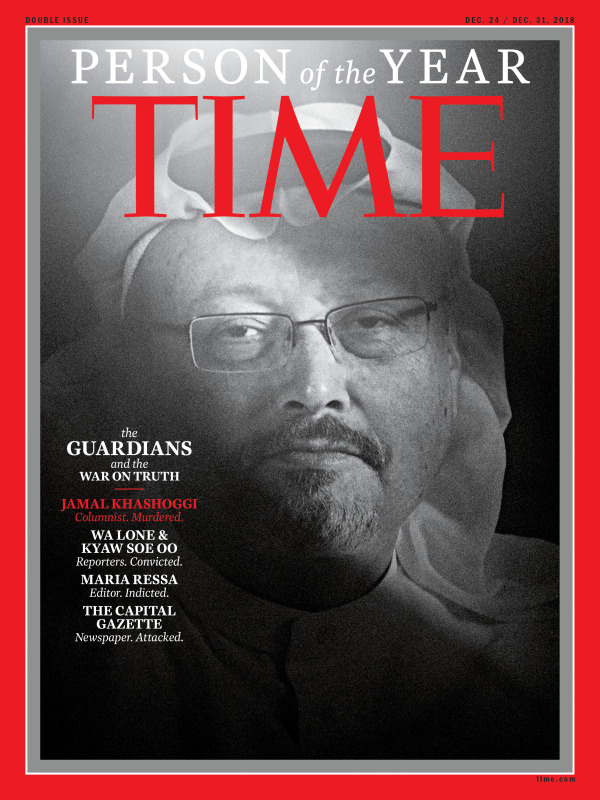
Bravo! to Time magazine choosing a group of journalists as their "Person of the Year." A great reminder of what many news people go through to bring the truth out in the age of abuse, assassinations and Donald Trump. 

The deserved honorees and horribly treated news people include murdered newsman Jamal Khashoggi, who is the first deceased person to win the honor, according to editors. Also the Capital Gazette newspaper in Annapolis, where five journalists were murdered; defiant international reporter Maria Ressa; and two jailed Reuters reporters in Myanmar, Kyaw Soe Oo and Wa Lone, each sentenced to seven years "for defying the ethnic divisions that rend that country (and) ... documenting the deaths of 10 minority Rohingya Muslims."

Read the great story HERE and see Time's insightful video on the choices below:

Thursday, October 18, 2018

A MURDERED JOURNALIST'S FINAL COLUMN AND A PRESIDENT'S DECEPTIVE BUSINESS TOP MUST READS TODAY

There are two important news items online today.

First, the final column from murdered Washington Post columnist Jamal Khashoggi, in which he emphasizes yet again how tyrannical governments are suppressing rights and press freedom.

Read it HERE.

You can also hear my Joe's Media Corner podcast talking to experts about Saudi Arabia's history of poor press treatment HERE.

Post Global Opinions editor Karen Attiah offered this note with the column explaining how it came about on his last apparent day alive:

I received this column from Jamal Khashoggi’s translator and assistant the day after Jamal was reported missing in Istanbul. The Post held off publishing it because we hoped Jamal would come back to us so that he and I could edit it together. Now I have to accept: That is not going to happen. This is the last piece of his I will edit for The Post. 

This column perfectly captures his commitment and passion for freedom in the Arab world. A freedom he apparently gave his life for. I will be forever grateful he chose The Post as his final journalistic home one year ago and gave us the chance to work together.

Also out this week is a great ProPublica investigation into the Trump Organization's history of misleading business colleagues and clients.

Among it's findings:

The Trumps were typically way more than mere licensors or bystanders in their often-troubled deals. They were deeply involved in these projects. They helped mislead investors and buyers — and they profited handsomely from it. 

Patterns of deceptive practices occurred in a dozen deals across the globe, as the business expanded into international projects, and the Trumps often participated. One common pattern, visible in more than half of those transactions, was a tendency to misstate key sales numbers.

See that report in full HERE.

Tuesday, October 9, 2018

WASHINGTON POST BEEFING UP ELECTION COVERAGE FOR 2020

If you think election coverage won't be big during the next two years, check out this ad for election reporters posted today at The Washington Post:

The Washington Post is looking for six reporters and an editor to expand our team covering the 2020 presidential election. 
These are once-in-a-lifetime jobs. 

The coming presidential campaign will be as hard-fought, captivating and consequential as any in recent memory, and The Post is committed to building on its leading role in political coverage. We are looking for reporters who can do it all: travel extensively, deliver scoops, spot off-beat tales, capture pivotal moments and write about the candidates in a revealing and compelling way. We also want people who are as eager to provide aggressive coverage of the administration that follows the election as they are the campaign. After the election, we will use these six additional reporting positions for increased accountability of the executive branch, although some individual reporters may end up remaining on the politics team or moving on to other areas of coverage. 

The ideal editor candidate relishes breaking news, has a proven ability to manage a large and collaborative team, and has an eye for innovative storytelling. We want someone who can shape and elevate a story and who enjoys working with photographers, graphic artists and videographers to find new ways to tell it. 

Applicants should send a letter describing their approach to political reporting, a resume and five clips to Peter Wallsten (peter.wallsten@washpost.com) and Tracy Grant (tracy.grant@washpost.com) by Oct. 22. In the subject line, please note “Election Editor” or “Election Reporter.”

Thursday, October 4, 2018

DAILY NEWSPAPER CIRCULATION DOWN 10%

This is not great news, from the Pew Research Center, among the best sources for media and other information:


State of the News Media: Newspapers Fact Sheet

WASHINGTON, D.C. (June 13, 2018) – The newspaper industry’s financial fortunes and subscriber base have been in decline since the early 2000s. A new Pew Research Center analysis of Alliance for Audited Media (AAM) data finds that in 2017 the estimated U.S. daily newspaper circulation (print and digital combined) was 31 million for weekday and 34 million for Sunday, down 11% and 10%, respectively, from the previous year.

Since 2004, Pew Research Center has published analyses of key audience and economic indicators for a variety of sectors within the U.S. news media industry. Instead of a single summary report, the Center now produces a series of fact sheets showcasing the most important and trendable data points for each sector in an easy-to-digest format. Today’s fact sheet focuses on the newspaper industry. Additional fact sheets will be rolled out over the coming months.

Among the key findings for newspapers:

Total estimated advertising revenue for the newspaper industry in 2017 was $16.5 billion, a 10% decrease from 2016 based on the Center’s analysis of financial statements for publicly traded newspaper companies. Total estimated circulation revenue was $11 billion, which is changed only slightly from 2016, up by 3%. Meanwhile, digital advertising accounted for 31% of newspaper advertising revenue in 2017. The portion stood at 29% in 2016.

In the fourth quarter of 2017, there was an average of 11.5 million monthly unique visitors (across all devices) to the top 50 U.S. daily newspapers, based on circulation, according to comScore data. This is nearly the same as in 2016 (11.7 million), making this the first year that did not show a double-digit rise in web traffic since Pew Research Center began tracking the trend.

Average minutes per visit to the websites of the top 50 U.S. daily newspapers, based on circulation, is about two-and-a-half minutes. This is roughly the same as 2016.

Despite overall declines in newspaper circulation, digital circulation rose for some national newspapers. In recent years The New York Times, The Wall Street Journal and The Washington Post have not fully reported their digital circulation to AAM, the group that audits the circulation figures of many of the largest North American newspapers and other publications. However, in independently produced reports, both The New York Times and The Wall Street Journal reported large gains in digital circulation in 2017: 42% for the Times and 26% for the Journal. But because these independently produced figures may not be counted under the same rules used by AAM, they are not included in the overall circulation analysis.

Average circulation for the top 20 U.S. alt-weekly newspapers is just over 55,000, a 10% decline from 2016 according to data from AAM, Verified Audit Circulation, Circulation Verification Council and independently produced reports. Alt-weekly newspapers are generally distributed for free in many U.S. cities and are heavily focused on arts and culture content.

According to data from the Bureau of Labor Statistics’ Occupational Employment Statistics, 39,210 people worked as reporters, editors, photographers or film and video editors in the newspaper industry in 2017. That is down 15% from 2014. Median wages in 2017 were about $49,000 for newspaper editors and about $34,000 for newspaper reporters.

Read the report: http://www.journalism.org/fact-sheet/newspapers/  


Wednesday, September 26, 2018

SEVERAL WHITE HOUSE REPORTERS NEED SECURITY DUE TO "CREDIBLE THREATS"

WHCA President Olivier Knox
At least three White House correspondents have obtained a security detail to protect them from "credible threats," according to White House Correspondents Association President Olivier Knox, who said the threats were at least in part caused by the ongoing anti-press view of many, including President Donald Trump. 

Knox spoke to me this week during an interview for my new podcast, Joe's Media Corner, which can be heard HERE.

"Until the Trump era I am not aware of any of my colleagues needing security details," Knox said during our interview on Tuesday. "There are several reporters in the press corps who need a security detail because they've had credible threats against their safety ... I know of three but I'm sure there are more. People tend to keep this hush-hush because they don't want to encourage people." 

Knox did not have the logistics of the security and declined to name specific people, but said "there has always been a fringe element that threatens reporters ... but you now have a president who encourages his followers to jeer at us and insult us and talks about how he will pay the legal fees of people who will beat up protesters and it trickles down."

Knox said the anti-press view dates back to when Trump first called out the press as outlaws soon after his inauguration.

"I still divide my career into pre- and post-February of 2017 because that's when the president called us the enemies of the people," he said, later noting that soon after that he was dropping his child off at a soccer practice and the boy "burst in to tears and said, 'Papa, is President Trump going to put you in prison?' That hits home and it also tells you the reach of the president's rhetoric on this stuff."

Knox, who became White House Correspondents Association president this past summer, also detailed what the organization does beyond the annual dinner, how the group is working to improve access to information, the recent cutback in daily briefings and how Trump is actually accessible in other ways. Listen HERE.

CHECK OUT MY NEW MEDIA PODCAST


I’m pleased to announce the launch of my new podcast: Joe’s Media Corner, which I hope to make at least a weekly production.

It will be found regularly at www.joesmediacorner.com and offer interviews and insight into a vast array of media issues and outlets  - from newspapers to broadcast and cable to the Internet and more. 

With my 30-plus years in journalism -- 18 of them on the media beat -- I hope to provide a different take on today’s news and media landscape, similar to what I post here, that goes outside of and beyond the expected issues and coverage. 

My first podcast, posted today, offers an in-depth interview with White House Correspondents Association President Olivier Knox. He discusses his take on the ongoing battle over press access in the White House, which he reveals has sparked at least three of his colleagues to obtain their own security detail due to threats.

You can find out more and listen to the first episode at www.joesmediacorner.com.

If you are interested in advertising or have any other views or information you can reach me at joe@joesmediacorner.com. More information on my background can be found at www.joestrupp.com.

Also, lookout for my new book on media issues and the real problems and challenges today’s news outlets face. 

It is set for publication in mid-October. More on that to come.

Thanks for reading and listening. 

Best, Joe