Thursday, January 31, 2019

NEW YORK TIMES CELEBRATES ROBINSON'S 100th BIRTHDAY WITH 100 PHOTOS SECTION

Photo: NY Times
Bravo to The New York Times, which ran a special 24-page section today on the 100th birthday of Jackie Robinson. Along with short stories on the hall of famer, it included 100 historic photos.

The section included no advertising, just reflections on the man properly praised for breaking the baseball color barrier back in 1947.  Robinson, who died in 1972, was described in the section as a "ballplayer, a change agent, a human being and humanitarian — of America, in progress."

"When we began our 2019 editorial planning, Jackie Robinson's 100th birthday stood out as a really important moment," Veronica Chambers, the paper's editor of archival storytelling said in a statement. "He's the very definition of an iconic American who continues to be relevant and inspiring, decades after his death. 

Photo: NY Times
"As we digitize the six million photos in our archives, the Past Tense editorial team has been creating stories and editorial packages with the photos we're discovering," she added. "Since Jackie Robinson stepped into history in Brooklyn, here in New York, we knew that we'd have a strong collection of images from which to begin the ambitious project of assembling 100 photos for his 100th birthday."
 
The photos go beyond his years with the Brooklyn Dodgers, to his time as a UCLA football player, a World War II U.S. Army soldier (who faced a court martial for refusing to move to the back of an Army bus some 11 years before Rosa Parks), and an early civil rights advocate.

Photo: NY Times
"As these photos make clear, Robinson’s decade in major-league baseball was just one act in a remarkably rich and complex life — one of vision, fortitude, dignity and endurance," editors wrote. "Shaped by the currents and contours of American history even as it recast them."

See it all HERE.

Monday, January 21, 2019

LESSONS FROM BUZZFEED AND THE VIRAL CATHOLIC STUDENTS VIDEO

Two controversial news stories that received widespread attention in the past few days, and have since come under scrutiny, point to some of the most important issues facing the news media today: accuracy and checking all facts.

First, Buzzfeed.com's report last Thursday that former Trump attorney Michael Cohen had been ordered by Trump to lie to Congress.

Buzzfeed posted the story Thursday evening, which stated: 

President Donald Trump directed his longtime attorney Michael Cohen to lie to Congress about negotiations to build a Trump Tower in Moscow, according to two federal law enforcement officials involved in an investigation of the matter.

Trump also supported a plan, set up by Cohen, to visit Russia during the presidential campaign, in order to personally meet President Vladimir Putin and jump-start the tower negotiations. “Make it happen,” the sources said Trump told Cohen.

The story drew wide-range reaction among many news outlets as the supposed bombshell gave them plenty to chew on for days, with some saying impeachment proceedings should begin.

On Friday, a spokesman for Special Prosecutor Robert Mueller issued a strong rebuke of the story, stating:

BuzzFeed's description of specific statements to the Special Counsel's Office, and characterization of documents and testimony obtained by this office, regarding Michael Cohen's Congressional testimony are not accurate

Buzzfeed has since stood by its reporting, with Editor-in-Chief Ben Smith telling CNN on Sunday that the news outlet sought reaction from Mueller's office before any story was posted and essentially received a "no comment." He had the emails to prove it.

But many have piled on Buzzfeed, which has come under scrutiny in the past, but also shown true investigative journalism. Trump supporters claim this is a sign that the president's baseless past claims of fake news are true. That is not the case, of course, and even humorous given that Trump lies far more often than any news site.

It will take some time to see how the story plays out before we know if it's right or wrong. But to attack the entire industry for what may or may not be an honest and rare mistake is unfair. 

The story is an indication of how anonymous sources, who were the origin of this story, can be both useful -- if it is accurate -- and problematic if it turns out not to be.

I address many of these issue in my new book, Killing Journalism: How Greed, Laziness (And Donald Trump) Are Destroying News And How We Can Save It (Willow Street Press). 

Another story of note is the viral video of some Kentucky high school students at the Lincoln Memorial on Friday that appears to show them taunting some Native American activists who were chanting and playing music. 

See the partial clip that made the rounds below: 


Initial reports claimed the students of Covington Catholic High School had been verbally abusing the Native Americans and shouting racist taunts at them. Many were also wearing pro-Trump "Make America Great Again" caps.

But later reporting found a much longer video that indicated the incident began when a group of what USA Today described as "Black Hebrew Israelites" confronted the Native Americans and accused them of losing their native lands because they "worshiped the wrong god."

The video shows that the high school students, who were in town for the annual Pro-Life March, entered the fray only after it had begun and, according to some, were also confronted by the Black Hebrew Israelites who made anti-Catholic comments.

See the lengthy video below:


This story is another example of what can happen when home-made video is posted online with no real explanation and a lack of context. Accusations fly, reactions are heated and misinformation gets out.

In both cases, first reactions appear to have been based on reporting that was at least partially wrong or incomplete. In the viral news world, they spark widespread misunderstanding and too often leave the well-meaning journalists with a lot of explaining to do.

Both are also reminders that first reports need to be carefully handled with efforts to fully explain a situation and give time and resources to completely report it. 

Tuesday, January 8, 2019

WHY THE NETWORKS SHOULD AIR PRESIDENT TRUMP'S ADDRESS

There's been lots of discussion and contention about President Trump's prime time address set for tonight, in which he plans to make his case for a border wall and the $5.7 billion he is requesting to build it. 

Should the major networks carry the address? As usual, it should be up to them to decide what their viewers want and need, and to the news departments to judge the validity of such an event.

Critics are saying this gives the president a place to lie, as he often does in public speeches. But his speech on a very newsy and controversial topic is, well, news. So much bickering and partisan views these days often creep into not only news coverage, but editorial decisions. This requires more and more that valid observations remain the most important guide.

The networks could choose not to broadcast the event and allow the cable news stations and other outlets -- including radio and online sites -- to provide coverage. No matter what the networks do, Trump's speech will be available in almost every case.

But to say the event is not news simply because the president is such a dishonest person misses the point. He is the president and what he does is news. One could argue that this address is more newsworthy than many of his tweets, which are always reported.

In both cases, they are news because of who is involved. The president simply by virtue of his position and power makes news with most of what he does. And his comments and arguments about such a controversial and divisive issue make it even more so. 

Some who oppose the networks broadcasting the speech point to a 2014 address by President Barack Obama on a similar issue, immigration, which was not carried by the main networks. A Washington Post story at the time pointed out that it was somewhat different in that it occurred during the coveted "sweeps" weeks and many thought ratings for Obama would be below those for The Big Bang Theory or Grey's Anatomy. 

"Presidential sweeps don't always ensure the exciting cliffhangers and plot twists that networks are looking for," The Post stated. But it also pointed out that many affiliates did carry the speech on their own, which drew some complaints that the regular programming was interrupted, adding "Some people were elated, while others reacted exactly as networks feared."

But one could argue that a Trump address on the border wall today will draw much higher ratings than an Obama speech on immigration four years ago. In the end, that is what many networks most want. Sure, there is a cynicism and downright greed involved in putting Trump out there because he is a ratings grab.

TV networks have no shame in putting out garbage that they know will bring viewers. Just last night the season premiere of The Bachelor filled three hours with embarrassing and vomit-making pseudo-drama that drew the expected large audience.

Still, there is an editorial reason behind the speech being shown. As stated earlier, he is the president and what he does is news, especially on such an important issue.

But it's also up to the networks and all of those who cover the speech to point out any and all inaccuracies and outright lies. Have the fact-checking systems in place that have served well since Trump's first presidential campaign announcement and put them to work. 

The public needs to see what their president says and does, but also receive clear, accurate information about what may not be true in his claims and why it affects them.

Tuesday, December 11, 2018

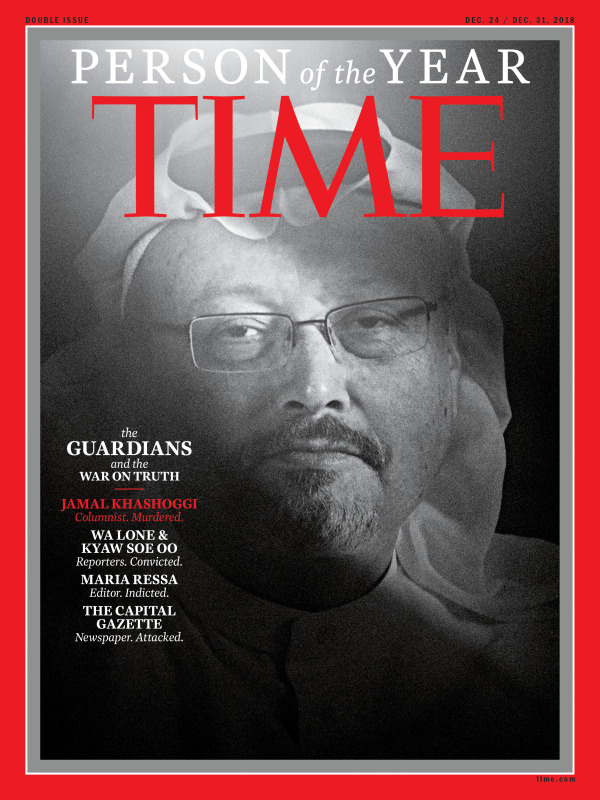
TIME CHOOSES JOURNALISTS AS "PERSON OF THE YEAR"

Bravo! to Time magazine choosing a group of journalists as their "Person of the Year." A great reminder of what many news people go through to bring the truth out in the age of abuse, assassinations and Donald Trump. 

The deserved honorees and horribly treated news people include murdered newsman Jamal Khashoggi, who is the first deceased person to win the honor, according to editors. Also the Capital Gazette newspaper in Annapolis, where five journalists were murdered; defiant international reporter Maria Ressa; and two jailed Reuters reporters in Myanmar, Kyaw Soe Oo and Wa Lone, each sentenced to seven years "for defying the ethnic divisions that rend that country (and) ... documenting the deaths of 10 minority Rohingya Muslims."

Read the great story HERE and see Time's insightful video on the choices below:

Thursday, October 18, 2018

A MURDERED JOURNALIST'S FINAL COLUMN AND A PRESIDENT'S DECEPTIVE BUSINESS TOP MUST READS TODAY

There are two important news items online today.

First, the final column from murdered Washington Post columnist Jamal Khashoggi, in which he emphasizes yet again how tyrannical governments are suppressing rights and press freedom.

Read it HERE.

You can also hear my Joe's Media Corner podcast talking to experts about Saudi Arabia's history of poor press treatment HERE.

Post Global Opinions editor Karen Attiah offered this note with the column explaining how it came about on his last apparent day alive:

I received this column from Jamal Khashoggi’s translator and assistant the day after Jamal was reported missing in Istanbul. The Post held off publishing it because we hoped Jamal would come back to us so that he and I could edit it together. Now I have to accept: That is not going to happen. This is the last piece of his I will edit for The Post. 

This column perfectly captures his commitment and passion for freedom in the Arab world. A freedom he apparently gave his life for. I will be forever grateful he chose The Post as his final journalistic home one year ago and gave us the chance to work together.

Also out this week is a great ProPublica investigation into the Trump Organization's history of misleading business colleagues and clients.

Among it's findings:

The Trumps were typically way more than mere licensors or bystanders in their often-troubled deals. They were deeply involved in these projects. They helped mislead investors and buyers — and they profited handsomely from it. 

Patterns of deceptive practices occurred in a dozen deals across the globe, as the business expanded into international projects, and the Trumps often participated. One common pattern, visible in more than half of those transactions, was a tendency to misstate key sales numbers.

See that report in full HERE.

Tuesday, October 9, 2018

WASHINGTON POST BEEFING UP ELECTION COVERAGE FOR 2020

If you think election coverage won't be big during the next two years, check out this ad for election reporters posted today at The Washington Post:

The Washington Post is looking for six reporters and an editor to expand our team covering the 2020 presidential election. 
These are once-in-a-lifetime jobs. 

The coming presidential campaign will be as hard-fought, captivating and consequential as any in recent memory, and The Post is committed to building on its leading role in political coverage. We are looking for reporters who can do it all: travel extensively, deliver scoops, spot off-beat tales, capture pivotal moments and write about the candidates in a revealing and compelling way. We also want people who are as eager to provide aggressive coverage of the administration that follows the election as they are the campaign. After the election, we will use these six additional reporting positions for increased accountability of the executive branch, although some individual reporters may end up remaining on the politics team or moving on to other areas of coverage. 

The ideal editor candidate relishes breaking news, has a proven ability to manage a large and collaborative team, and has an eye for innovative storytelling. We want someone who can shape and elevate a story and who enjoys working with photographers, graphic artists and videographers to find new ways to tell it. 

Applicants should send a letter describing their approach to political reporting, a resume and five clips to Peter Wallsten (peter.wallsten@washpost.com) and Tracy Grant (tracy.grant@washpost.com) by Oct. 22. In the subject line, please note “Election Editor” or “Election Reporter.”

Thursday, October 4, 2018

DAILY NEWSPAPER CIRCULATION DOWN 10%

This is not great news, from the Pew Research Center, among the best sources for media and other information:


State of the News Media: Newspapers Fact Sheet

WASHINGTON, D.C. (June 13, 2018) – The newspaper industry’s financial fortunes and subscriber base have been in decline since the early 2000s. A new Pew Research Center analysis of Alliance for Audited Media (AAM) data finds that in 2017 the estimated U.S. daily newspaper circulation (print and digital combined) was 31 million for weekday and 34 million for Sunday, down 11% and 10%, respectively, from the previous year.

Since 2004, Pew Research Center has published analyses of key audience and economic indicators for a variety of sectors within the U.S. news media industry. Instead of a single summary report, the Center now produces a series of fact sheets showcasing the most important and trendable data points for each sector in an easy-to-digest format. Today’s fact sheet focuses on the newspaper industry. Additional fact sheets will be rolled out over the coming months.

Among the key findings for newspapers:

Total estimated advertising revenue for the newspaper industry in 2017 was $16.5 billion, a 10% decrease from 2016 based on the Center’s analysis of financial statements for publicly traded newspaper companies. Total estimated circulation revenue was $11 billion, which is changed only slightly from 2016, up by 3%. Meanwhile, digital advertising accounted for 31% of newspaper advertising revenue in 2017. The portion stood at 29% in 2016.

In the fourth quarter of 2017, there was an average of 11.5 million monthly unique visitors (across all devices) to the top 50 U.S. daily newspapers, based on circulation, according to comScore data. This is nearly the same as in 2016 (11.7 million), making this the first year that did not show a double-digit rise in web traffic since Pew Research Center began tracking the trend.

Average minutes per visit to the websites of the top 50 U.S. daily newspapers, based on circulation, is about two-and-a-half minutes. This is roughly the same as 2016.

Despite overall declines in newspaper circulation, digital circulation rose for some national newspapers. In recent years The New York Times, The Wall Street Journal and The Washington Post have not fully reported their digital circulation to AAM, the group that audits the circulation figures of many of the largest North American newspapers and other publications. However, in independently produced reports, both The New York Times and The Wall Street Journal reported large gains in digital circulation in 2017: 42% for the Times and 26% for the Journal. But because these independently produced figures may not be counted under the same rules used by AAM, they are not included in the overall circulation analysis.

Average circulation for the top 20 U.S. alt-weekly newspapers is just over 55,000, a 10% decline from 2016 according to data from AAM, Verified Audit Circulation, Circulation Verification Council and independently produced reports. Alt-weekly newspapers are generally distributed for free in many U.S. cities and are heavily focused on arts and culture content.

According to data from the Bureau of Labor Statistics’ Occupational Employment Statistics, 39,210 people worked as reporters, editors, photographers or film and video editors in the newspaper industry in 2017. That is down 15% from 2014. Median wages in 2017 were about $49,000 for newspaper editors and about $34,000 for newspaper reporters.

Read the report: http://www.journalism.org/fact-sheet/newspapers/